

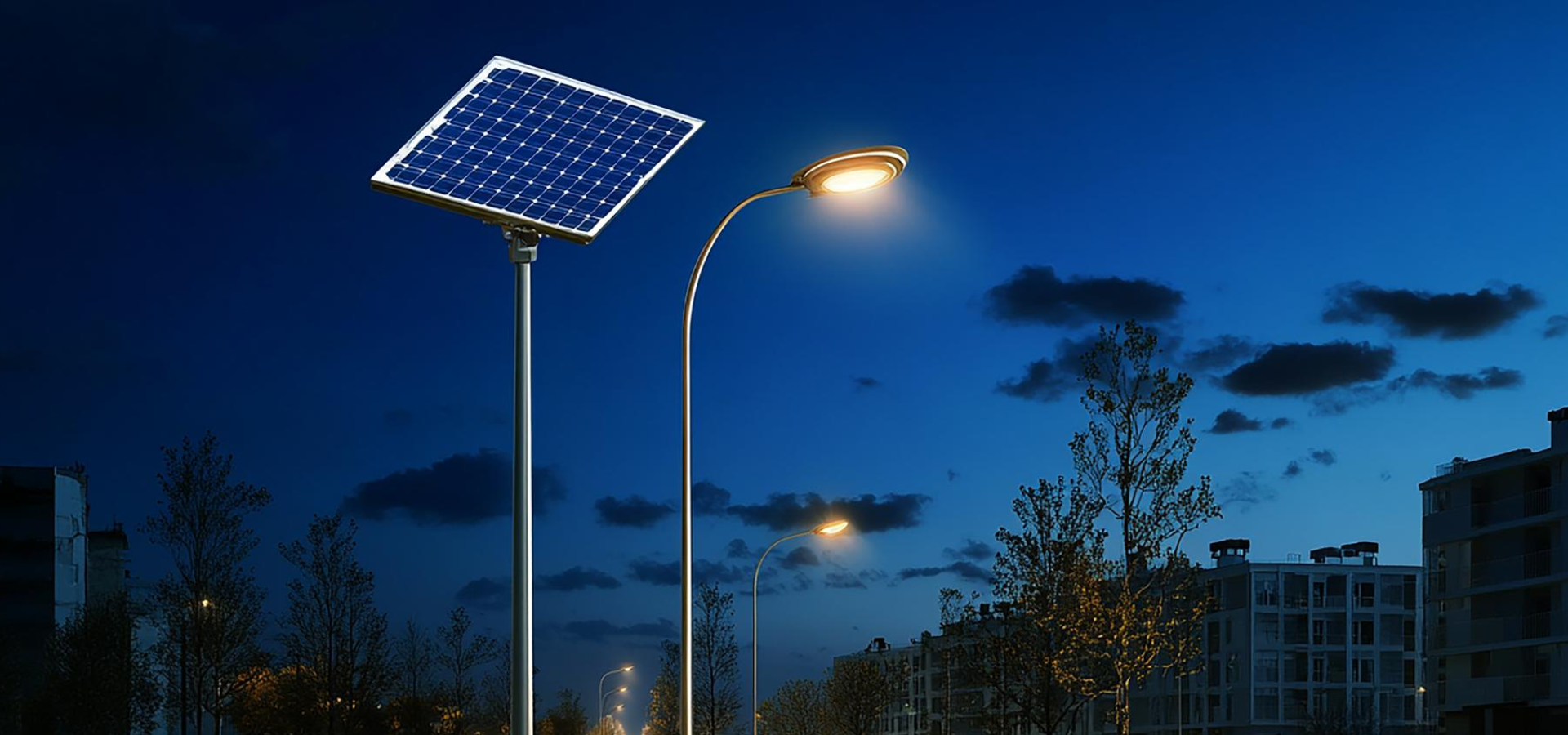
How do you choose the right solar street light for highways, roads and public spaces? Highways generally require 60 to 120W systems with taller poles, roads typically need 30 to 60W systems and public spaces often work well with 12 to 30W fixtures. The right choice should also consider lumens, pole height, battery technology, road width, lighting design and applicable MNRE, BIS and ALMM requirements.
Outdoor lighting looks simple only until the wrong specification reaches the site.
A light that works perfectly for a residential road may not provide sufficient visibility on a highway. A system designed for a large carriageway may be unnecessarily powerful and expensive for a park or public plaza. That is why choosing the right solar street light should begin with the application, not simply with the wattage printed on the product.
Across India, infrastructure planners, municipalities, developers and public agencies are increasingly exploring solar lighting for highways, urban roads, campuses and public spaces. The appeal is clear. Solar-powered systems can reduce dependence on grid electricity, simplify installations in suitable locations and support wider sustainability goals.
However, a solar street light for highways must meet very different performance expectations from one installed on a footpath or in a landscaped park.
This guide explains how to select the right system for each environment and what technical factors to check before procurement.
Why Solar Street Light Selection Differs by Application
There is no single street-lighting specification that works equally well everywhere.
The right system depends on how the space is used, how much visibility it requires and how critical the lighting is to safety.
A solar street light for roads must account for vehicle speed, lane width, pedestrian movement, pole spacing and surrounding ambient light.
A solar street light for public spaces may need to balance functional illumination with visual comfort and design aesthetics.
Some of the most important factors include traffic density, road width, mounting height, illumination level, beam spread, operating hours and surrounding darkness.
Battery capacity also matters because the lighting system must store enough solar energy during the day to provide dependable illumination at night.
Solar irradiation at the installation location should also be considered. Shading from trees, nearby buildings, or infrastructure can affect charging performance and therefore influence system sizing.
The goal is not to install the most powerful light available. It is to install the right lighting system for the intended environment.
Solar Street Lights for Highways
Highways are among the most demanding locations for outdoor lighting.
Vehicles travel at significantly higher speeds and motorists require good visibility to identify lane markings, turns, intersections and potential hazards.
For this reason, selecting a solar street light for highways requires careful attention to light output, pole height, optical distribution and system reliability.
Recommended Wattage and Lumens
For many highway applications, systems in the range of approximately 60 to 120W may be considered depending on the width of the carriageway, pole spacing and required illumination.
Projects requiring stronger illumination can consider systems delivering approximately 8,000 lumens or more, depending on lighting calculations and specifications.
Wattage alone, however, should not determine performance.
Two 100W street lights can produce different results depending on LED efficiency, optical design and the quality of their components.
For larger carriageways, junctions, toll areas and wide infrastructure zones, a solar high mast light can provide wider illumination coverage from an elevated mounting position.
High-mast systems can also reduce the number of individual poles required in certain large-area applications when supported by an appropriate lighting design.
Pole Height
Highway installations generally require taller poles than urban streets.
Pole heights can typically begin around 8 metres and can extend towards 20 metres for high-mast applications or wide infrastructure stretches.
The exact height should depend on carriageway width, fixture output, road geometry and required lux levels.
For expressways and NHAI-related infrastructure, the lighting design should always follow the specifications prescribed for the project rather than relying on a generic pole-height recommendation.
MNRE, BIS and ALMM Requirements for Highway Projects
Compliance becomes especially important when solar lighting forms part of a government tender or public infrastructure project.
MNRE publishes specifications related to solar street-lighting systems, including specifications covering performance requirements for solar lighting components.
An ALMM solar street light requirement should also be interpreted correctly.
ALMM does not certify the complete street-light fixture. It identifies approved models and manufacturers of solar PV modules and solar PV cells. MNRE’s current framework includes List-I for PV modules and List-II for PV cells.
For applicable government projects, buyers should therefore check whether the solar PV modules proposed for the system meet the latest ALMM requirements specified in the tender.
Other applicable BIS standards, testing requirements and technical tender conditions should also be reviewed before procurement.
Solar Street Lights for Arterial and Residential Roads
Urban roads require a more balanced lighting solution.
These streets generally carry slower traffic than highways, but they may have greater interaction between vehicles, pedestrians, cyclists and nearby residential or commercial activity.
A solar street light for roads in these environments should therefore deliver sufficient visibility without unnecessarily oversizing the system.
Recommended Wattage and Pole Height
For arterial and residential roads, systems between approximately 30 and 60W can suit many applications.
Pole heights usually fall within the 6 to 8 metre range.
The exact configuration depends on factors such as road width, fixture spacing, traffic movement and the required illumination level.
When selecting a solar street light for Pune infrastructure projects, durability should also be considered because systems may need to withstand heavy monsoon conditions, dust and seasonal weather changes.
For a solar street light Mumbai project, resistance to rainfall, humidity and long-term outdoor exposure becomes equally important.
Appropriate IP-rated enclosures can help protect critical electrical components against dust and water ingress.
LiFePO₄ Battery vs Lead-Acid Battery
- Battery technology is one of the most important parts of a solar lighting system.
- It determines how effectively energy generated during the day is stored and delivered after sunset.
- LiFePO4 batteries have become increasingly popular in modern solar lighting systems because they offer a comparatively high cycle life, good thermal stability and compact installation.
- They also generally require less routine maintenance than traditional lead-acid batteries.
- Lead-acid batteries may offer a lower upfront price in some systems, but buyers should also consider replacement cycles, maintenance and total cost over the operating life of the project.
- For roads expected to operate reliably for years, the battery decision should therefore be based on lifecycle performance rather than purchase price alone.
Solar Lighting for Public Spaces: Parks, Squares and Footpaths
Lighting public spaces is not just about visibility.
It also influences how welcoming, comfortable and usable an environment feels after sunset.
A solar street light for public spaces can be considered for gardens, campuses, pathways, promenades, plazas and recreational environments.
Unlike highways, these locations usually do not require extremely high-output fixtures.
Instead, design quality, visual comfort and appropriate light distribution become equally important.
Decorative and All-in-One Fixtures
For many public-space applications, approximately 12 to 30W lighting systems can provide a practical starting range.
Pole heights typically fall between 4 and 6 metres depending on the area being illuminated.
A decorative solar street light can also complement landscape architecture while providing functional lighting.
Decorative fixtures can be particularly effective around pathways, gardens, plazas and hospitality spaces where appearance contributes to the overall experience.
All-in-one systems are another option.
These fixtures typically combine major solar lighting components into a compact structure, helping create a neat and contemporary appearance.
Semi-integrated systems may be preferred when greater flexibility is required in positioning the panel, battery or fixture.
Comparison Table: Highway vs. Road vs. Public Space
The most suitable specification becomes easier to understand when the three primary applications are compared directly.
| Application | Wattage | Pole Height | Fixture Type |
| Highway | 60–120W | 8–20m | Solar High Mast |
| Arterial Road | 30–60W | 6–8m | Semi-Integrated/AC Street Light |
| Public Space | 12–30W | 4–6m | All-in-One/Decorative |
These values should be treated as practical reference ranges rather than fixed specifications.
A professional lighting design should still consider required lux levels, spacing, beam distribution, local solar conditions and site-specific safety requirements.
What Else Should You Check Before Selecting a Solar Street Light?
Choosing the correct application category is only the beginning. Several technical factors determine how well the system performs after installation.
Light Output and Efficiency
- Do not compare products only by wattage.
- Lumens indicate the amount of visible light produced by the fixture.
- LED efficiency also determines how effectively electrical power is converted into useful illumination.
- A lower-wattage fixture with better efficiency can sometimes perform better than a higher-wattage product with poor optical design.
Beam Distribution
- The shape of the light beam matters as much as total output.
- Road lighting should distribute light across the carriageway rather than concentrating it directly beneath the pole.
- For wider roads, appropriate optics can improve uniformity and reduce dark zones between poles.
Solar Panel Capacity
- The solar panel must generate enough energy during daylight hours to recharge the battery.
- Its capacity should therefore match the power consumption of the fixture and the expected operating duration.
- Sites with lower solar exposure may need larger panel capacity or revised system sizing.
Battery Backup
- Solar lighting systems should be capable of operating through expected night hours and periods of reduced sunlight.
- Battery autonomy becomes particularly important during monsoon periods or consecutive cloudy days.
- Buyers should confirm battery capacity, expected backup duration and the operating logic of the controller.
Smart Lighting Controls
- Modern solar street lights can also use programmable controllers or motion-based dimming.
- For example, the fixture may operate at full brightness during peak hours and reduce output during periods of low activity.
- Such controls can reduce energy consumption and extend battery runtime when appropriately designed.
Compliance Checklist Before You Buy
Technical compliance should be reviewed before issuing a purchase order, particularly for government or institutional projects.
An MNRE-approved solar street light should not be selected merely because a supplier uses that phrase in marketing material.
Instead, buyers should check the actual MNRE specifications and tender requirements applicable to the project.
MNRE currently lists specifications for solar street lights and related solar photovoltaic lighting systems.
For an ALMM solar street light requirement, buyers should verify the eligibility of the PV module and, where applicable, relevant PV cell requirements under the latest ALMM framework.
Before procurement, check:
- Applicable BIS certification or testing requirements
- Relevant MNRE technical specifications
- ALMM status of applicable solar PV modules
- IP65 or IP66 protection where required
- LED performance and luminous efficiency
- Battery chemistry and rated lifecycle
- Solar panel capacity
- Charge-controller specifications
- Pole quality and structural design
- Product and component warranties
- Installation support
- After-sales service
Government tender requirements can change by project and authority, so the latest tender documentation should always take priority.
Common Mistakes to Avoid When Buying Solar Street Lights
- One of the most common mistakes is choosing a system based entirely on price.
- A lower upfront cost does not necessarily mean better lifecycle value.
- Battery replacement, fixture failures, poor illumination and higher maintenance requirements can make an initially inexpensive system much more costly over time.
- Another mistake is selecting wattage without studying pole spacing.
- Even a powerful fixture can create inconsistent illumination when poles are positioned incorrectly.
- Ignoring solar exposure is equally risky.
- A panel installed beneath tree cover or in persistent shade may not generate enough energy to fully recharge the battery.
- Finally, buyers should avoid assuming that all products carrying similar wattage labels offer identical performance.
- Component quality, optics, batteries, panels and control systems can vary substantially between manufacturers.
Why Proper Lighting Design Matters
- Street-lighting design is ultimately about achieving the right amount of illumination in the right place.
- On a highway, this can contribute to safer movement and better visibility at night.
- On an arterial road, it can help motorists and pedestrians navigate more comfortably.
- In public spaces, lighting can improve usability while supporting the character of the environment.
- That is why project planners should consider lux calculations, pole spacing, fixture placement and lighting uniformity before finalising the product.
- For large installations, a site-specific lighting plan can also help prevent both under-lighting and unnecessary over-specification.
Choosing a Reliable Solar Street Light Manufacturer
Product specifications are important, but the manufacturer behind the system also matters.
A reliable supplier should be able to explain the performance of the complete system rather than simply promoting fixture wattage.
Buyers should ask for technical specifications covering the LED fixture, solar panel, battery, controller and pole.
Warranty terms should also clearly mention which components are covered and for how long.
Project experience is another useful factor to consider because highway, municipal and public-infrastructure projects can involve very different technical requirements.
Starka offers solar lighting solutions designed for different outdoor applications and infrastructure requirements. Buyers can explore suitable configurations according to the scale, location and lighting needs of their project.
FAQs
1. What wattage solar street light is suitable for highways?
Highway applications commonly use approximately 60 to 120W systems depending on road width, pole spacing and illumination requirements.
2. What pole height is suitable for highway solar lighting?
Highway poles generally begin around 8 metres, while high-mast installations can extend towards 20 metres depending on the application.
3. What wattage is suitable for residential and arterial roads?
Approximately 30 to 60W systems are commonly considered for arterial and residential road applications.
4. Which battery is better for solar street lights?
LiFePO₄ batteries are widely preferred for modern systems because of their long cycle life, compact size and low maintenance requirements.
5. What type of solar street light is suitable for parks?
All-in-one or decorative fixtures in approximately the 12 to 30W range can suit many parks, pathways and landscaped spaces.
6. Are solar street lights suitable for government projects?
Yes, provided the system and its components meet the applicable tender specifications, MNRE requirements and relevant standards.
7. What does ALMM mean for solar street lights?
ALMM primarily applies to approved solar PV module and cell models and manufacturers rather than certifying the complete street-light fixture.
Conclusion
Choosing the right solar lighting system begins with understanding where it will be installed.
Highways require higher output, taller poles and carefully planned light distribution. Urban roads need balanced illumination with reliable battery performance. Parks and public spaces can prioritise lower wattage systems, visual comfort and aesthetically designed fixtures.
The best solar street light is therefore not simply the one with the highest wattage. It is the system that matches the application, provides dependable illumination and uses appropriately specified components.
For large infrastructure projects, a Solar LED Highmast Light can provide effective coverage across wider areas when supported by proper lighting design.
Buyers should also review MNRE specifications and applicable ALMM requirements before finalising systems for government procurement.
For application-specific solar lighting solutions for highways, roads and public spaces, explore Starka’s product range and connect with the team at Starka Solar to identify a system suited to your project’s technical and operational requirements.
Related Posts
Solar Street Light Manufacturer | Starka Solar